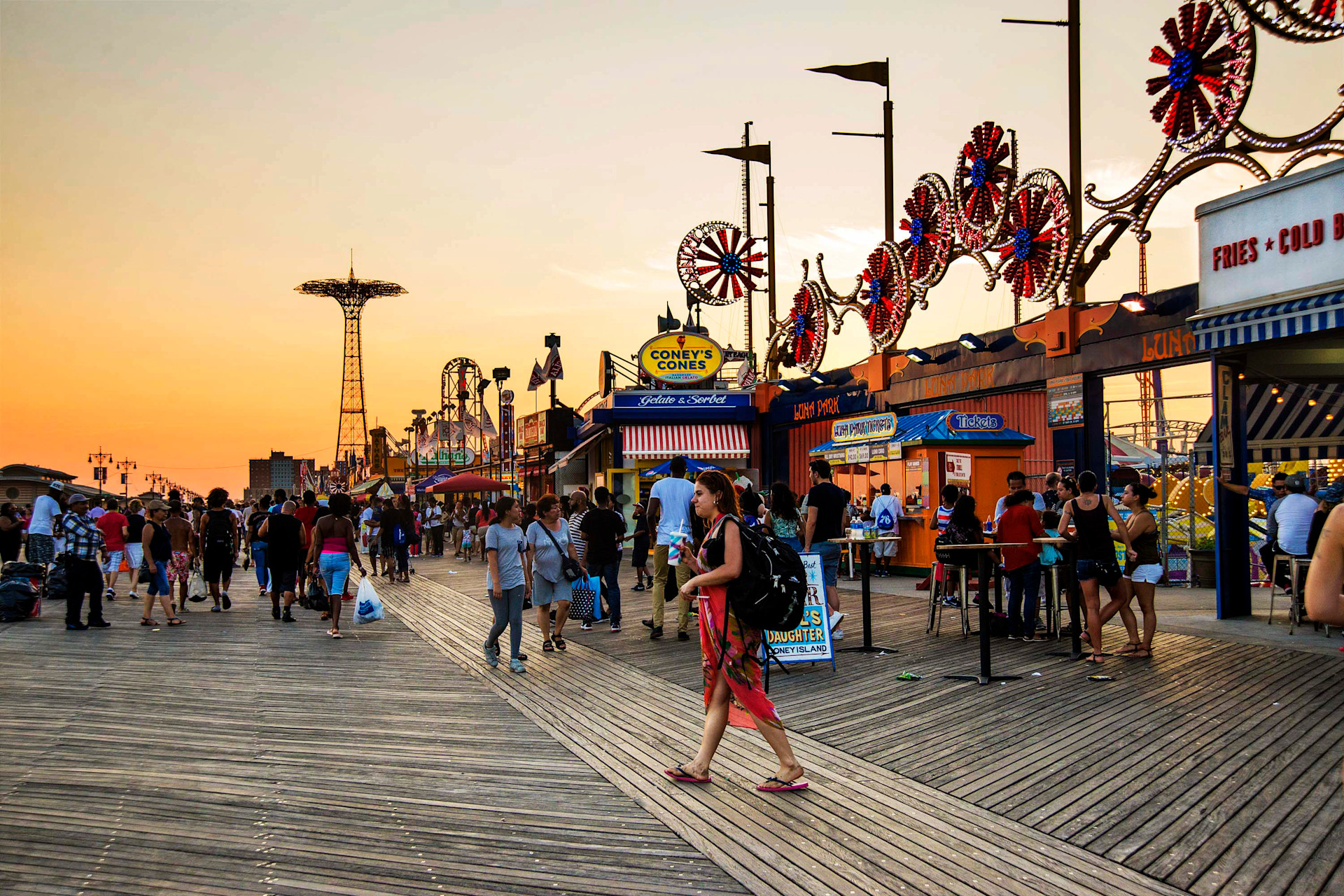
Coney Island, at Brooklyn’s southern tip on the Atlantic, is famous for its beach, the Riegelmann Boardwalk and an amusement area with the Cyclone roller coaster and the Wonder Wheel. It is also a neighbourhood where people live all year round.
Coney Island began as a seaside resort in the nineteenth century, when railways and ferries brought New Yorkers to its beaches and hotels. In the early 1900s its large amusement parks, Steeplechase Park, Luna Park and Dreamland, made it one of the best-known leisure destinations in the world. Several of those parks later closed or burned, but the amusement area never disappeared, and today’s Luna Park, which opened in 2010, continues the tradition. Despite its name, Coney Island is no longer an island: the creek that once separated it from the mainland was filled in during the twentieth century.
The Riegelmann Boardwalk, which opened in 1923, runs for about 2.5 miles (4 km) beside the beach. The Wonder Wheel, a Ferris wheel from 1920 with swinging cars, and the Cyclone, a wooden roller coaster from 1927, are both New York City landmarks. The Parachute Jump, a tower that came from the 1939 World’s Fair, no longer carries riders but is lit up at night and has become a symbol of the area. Nathan’s Famous opened here in 1916 and holds its hot-dog eating contest every Fourth of July.
Coney Island is also a community, and its calendar goes beyond summer weekends. The Mermaid Parade, held each June, celebrates the neighbourhood’s artists and eccentrics, and Coney Island USA runs the Coney Island Museum and the Sideshows by the Seashore. The New York Aquarium, run by the Wildlife Conservation Society, stands at the western end of the amusement area, and MCU Park, beside the beach, is where the Brooklyn Cyclones play minor-league baseball in season. Check schedules and opening hours, because many rides, shops and events are seasonal.
Coney Island–Stillwell Avenue is the terminus of the D, F, N and Q subway lines, so the boardwalk is a direct, if long, ride from Manhattan, and several bus routes serve the neighbourhood. Housing is a mix of public-housing developments, older apartment buildings and newer residential towers, and the area blends into Brighton Beach to the east and Gravesend to the north. Ask residents and the local community board how tourism, new development and the year-round community fit together before you rent or buy.
Coney Island sits on a low peninsula between the ocean and Coney Island Creek, and it was badly flooded by Hurricane Sandy in 2012, when many homes and businesses were damaged. If you rent or buy here, check the property’s flood zone and your insurance options, and sign up for Notify NYC emergency alerts. On summer weekends the beach and the boardwalk are very crowded; swim only where lifeguards are on duty, since they work during the beach season only.
What’s in Coney Island
Places

Coney Island Boardwalk
The beach, the 2.5-mile Riegelmann Boardwalk and the amusement area at Brooklyn’s southern tip: rides, hot dogs, concerts and an Atlantic sunset. Beach lifegua…

The Cyclone
A wooden roller coaster that opened in 1927 and is a New York City landmark. It is one of the signature rides of Coney Island’s amusement area.

Wonder Wheel & Luna Park
The Wonder Wheel, a Ferris wheel from 1920 with swinging cars, stands beside Luna Park, the modern amusement park that reopened on the site of the old Astrolan…

New York Aquarium
The aquarium run by the Wildlife Conservation Society has stood at Coney Island since 1957, with sea otters, sharks, penguins and a focus on ocean conservation.